
The Cynicism Machine: Private Equity, Power, and the AI Accelerant
Why it all feels like it just doesn't matter anymore.

Conceptualize the following scenario — A typical small/medium business story from the past 10 years.
A medium-sized private equity firm acquires an established small-cap company for $90 million. The equity group puts up $30 million of its own capital, while the company itself takes on $60 million in debt to finance the remainder of its own acquisition. This leveraged buyout model, typical today, results in debt servicing falling on the company's operating revenue bottom line.
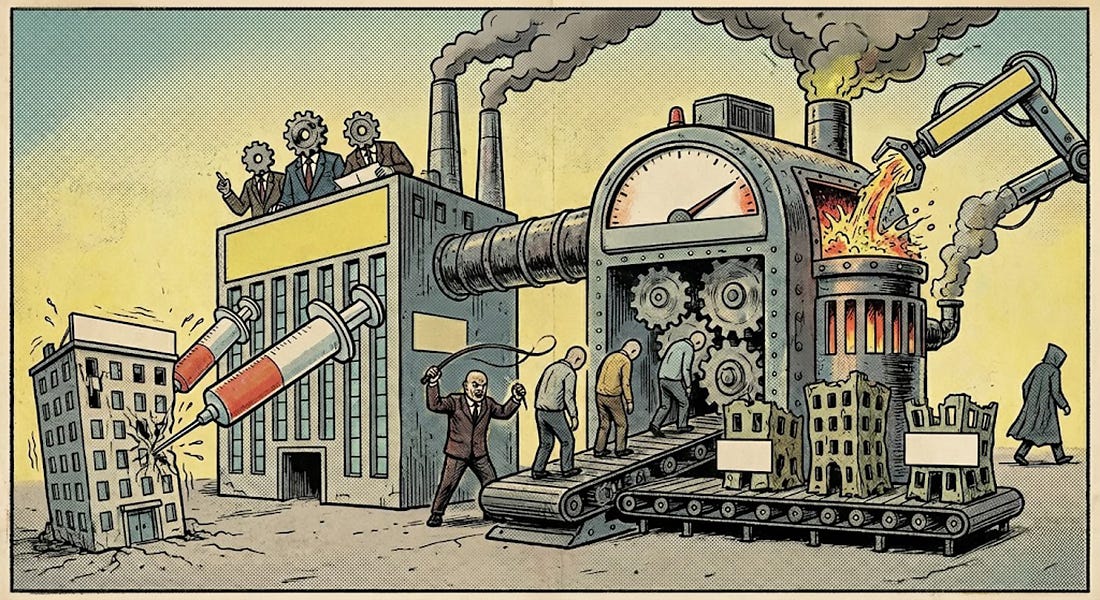
The playbook from here is simple: improve revenue and EBITDA aggressively, direct as much operating cash flow as possible toward paying down that debt (or sell assets where possible), and flip the company in three to five years at a higher multiple. If the company retires $30 million of debt during the hold period and sells for $120 million, the firm clears $90 million on a $30 million investment — a 3x return. The company, meanwhile, spent those years funneling its own cash into servicing the acquisition debt while optimizing for a single metric — top-line growth — at the expense of everything else it may have once done well.
This model has reshaped entire sectors of the economy. Healthcare systems, education companies, service providers, utilities — organizations built around missions to improve patient outcomes, learning, public infrastructure — now operate under debt structures that demand quarter-over-quarter revenue growth as the singular organizational priority. And PE exit windows are getting longer. Firms that planned three-to-five-year holds are sitting at seven, eight, nine years, unable to find buyers at the multiples they need. The longer they hold, the harder the squeeze. The harder the squeeze, in many cases, the less remains of whatever value the company once held dear as the core mission.
The result is an expanding population of what can only be described as zombified companies. Everything from dentists to plumbers. Even when the PE-ownership-driven immense growth demands are met (spoiler: by and large, they are not), the end result is organizations that have hollowed out any of their actual capacity to create real value, retain talent, or generate original and meaningful ideas.
Still operating and billing, but ultimately, no longer producing any real value, despite what the board reports might be saying. This model is profitable for investors, which is why they are so prolific. But as a whole, shifting the mission of any organization to be solely focused on investor value will inevitably have a significant negative impact on culture, value, and in some cases, critical social and public services.
This is a story about how that happens — and why AI, rather than offering a way out, could lock the door behind them.
The Mission Problem
Jeremy Boring, co-founder of the Daily Wire, describes a principle in a recent Triggernometry episode that applies well:
When an organization places profit or revenue at the top of its priority stack as “The Mission”, every other priority will succumb and subordinate to it. It is impossible for any other initiative to coexist. They must serve the mission.
This is structural. A company carrying $60 million in acquisition debt does not have the luxury of protecting its R&D budget through a slow quarter. A hospital system reporting to PE-backed ownership does not get to prioritize patient outcomes over billing volume. The debt structure makes the decision before any individual leader walks into the room.
Boring identifies what happens next: cynical decisions and a cynical mindset.
In this context, cynicism is not merely a negative attitude or general distrust; it is the deliberate decoupling of an institution’s stated values from its survival mechanism. It is a distinct form of corporate nihilism where the product is no longer viewed as the end goal, but merely as the friction one must endure to extract revenue to facilitate the private equity firm’s eventual exit.
These cynical decisions are short-term choices that trade long-term capacity for immediate financial performance. And cynicism compounds. A company that makes a few cynical choices to service its debt will inevitably and unequivocally become a cynical organization. People inside start to see every initiative — every new hire, every product idea, every strategic conversation — through the lens of short-term extraction.
Boring puts it bluntly: you do not wield cynicism for long before cynicism wields you. No more is this blatantly apparent than at the organization level that has taken on this model.
The Enforcement Layer
Once revenue occupies the top of the priority stack, the organization needs a mechanism to enforce compliance. Brené Brown’s research on organizational power dynamics offers a model that many reading this are likely already all too familiar with. She speaks to it in a recent Diary of a CEO podcast.
Brown identifies four types of power: power over, power with, power to, and power within. The first (power over) operates from a belief that power is finite — that sharing it creates a deficit, that it must be hoarded and protected. The other three treat power as something that grows when distributed.
Organizations under financial pressure default to power over almost without exception. The logic follows directly from the debt structure: if the sole objective (“the mission”) is to improve EBITDA (the service of the investor), and employees are the mechanism for producing that output, control becomes the management philosophy. Consequences and fear are pervasive leverage over the internal structure.
Brown identifies a constraint that makes this model inherently unstable. Human beings cannot sustain a fear response indefinitely. Subjected to constant threat of termination, demotion, or public consequence, people either go numb or normalize the conditions. They stop responding, stop caring, and stop trusting. Almost certainly, the best and brightest will quickly begin looking elsewhere for stability. They will seek to create their own psychological safety nets in the form of side gigs, secretly job hunting, or hoarding cash.
As they begin to build this stability, it will become easier and easier to check out, quiet quit, and stop caring — the underlying mission, growth at all costs so that the PE firm can exit, was never of any interest to them anyway, beyond a constant paycheck and managing their next mortgage payment.
Don’t get me wrong, given the scope of PE-owned companies, there are a lot of people who are seeing personal career success and wealth from this model, including myself. However, unless you are a complete narcissistic sociopath, there is an extremely high ongoing personal and cultural cost to benefiting from this model. The thrill of a hefty paycheque is offset rapidly by watching close friends exited one after another, without warning. The constant pressure to impact the bottom line, achieving often impossible targets, and in leadership, the need to constantly sink into sycophancy to just stay employed.
There are certain types of people who thrive in this world — and thus why the leadership for so many of these companies is rife with blatant narcissists, hyper-focused on power, control, and perception as the only thing that matters with little disregard for much else (much less empathy).
And so, it is fitting, as Brown describes it, that this archetype of leadership must engage in periodic acts of cruelty to re-establish the fear. A sudden firing. A public humiliation. Undermining of individuals. Cutting off (or attempting to cut off) inter-workforce communication. Narration or alignment hyper-vigilance. The inexplicable elimination of maybe even an entire team without warning.
These moves are fundamentally structural requirements. The power-over model demands them to function and enforce the service of the core mission — growth at all costs.
The workforce learns two lessons very quickly: keep your head down, and do not challenge the direction. At the organizational level, both are fatal to idea generation and ultimately, the sustainability of the business.
The Cynicism Feedback Loop
Revenue-as-mission creates the incentive structure. Power over creates the enforcement mechanism. Together, they produce a structural organizational model that is simultaneously pressured to perform and conditioned not to think independently.
Capable people inside these organizations still see problems, still see opportunities, still have ideas worth pursuing. But they learn — through observation, through the periodic cruelty Brown describes, through watching colleagues who pushed back get pushed out — that raising those ideas carries risk and never carries reward. The rational response is to stop trying.
This is not disengagement from laziness. It is a calculated survival strategy inside a system that punishes initiative and rewards compliance. The organization gets exactly what it optimizes for: a workforce that executes assigned tasks and generates zero strategic value beyond that execution.
The feedback loop closes. Leadership perceives a lack of ideas coming from the organization and may even determine that talent is weak. The talent sees leadership ignoring or punishing the ideas that do surface and concludes the organization is not serious. Both sides are indeed correct about the other. Neither sees the system producing the outcome, which is not value-driven but instead revenue-driven.
AI: Fuel on the Fire
Dax Raad recently made a set of observations about AI adoption in organizations that land directly in this context. Companies talk about their engineering teams as though they were operating at peak efficiency, held back only by the speed at which they could produce code. Being an engineer myself, I can tell you this is far from the case. The old adage that the best engineers are lazy is in fact true. The highest performing people are not writing code 40 hours a week, but rather a fraction of that, at high efficiency and conserving their mental energy for complexity, not throughput.
Further, counting lines of code written is almost certainly the least effective marker of success. Anyone who has worked in software development in any capacity can attest to this.
The truth is that most organizations rarely have good ideas. The expense of implementation was a pretty effective mask for this. When building something required significant time, effort, and coordination, bad ideas died in prioritization. Cost functioned as a filter.
AI removes the filter. And in (primarily product) organizations already running on cynicism and power over, what fills the vacuum is not innovation. It is volume. The majority of employees — already disengaged, already conditioned to execute rather than think — will use AI to produce their assigned output with less effort. Those who genuinely cared about quality find themselves buried; the trusted few who have shown the kind of initiative that creates true value will find themselves oversubscribed. The bureaucratic bottlenecks that existed before AI — approvals, cross-functional alignment, compliance review, the dozen realities of actually shipping something — remain exactly where they were.
The organization that does not optimize for this new world will simply spend more. Raad flags the additional $2,000 per engineer per month in LLM costs alone. It produces more output. It gets no closer to solving its actual problem, which was never production speed. The problem was and remains the gap in vision, trust, and idea flow, along with true empowerment and adoption from the needed stakeholders to see it through.
And here is where the PE model and the AI narrative converge. AI investment is attracting enormous capital precisely because it fits the extraction playbook. It promises to cut headcount — a direct operating cost reduction that shows up immediately on a P&L. It inflates technology valuations, which lets PE firms borrow against portfolio companies at higher multiples, raise more capital, acquire more businesses, and repeat the cycle. AI is not disrupting the extraction model. It is the extraction model’s most efficient new instrument.
And there are two sides to this. As a business leader, someone whose job it is to serve the investors, there is truly no choice here. There is no question that we are going to see most large organizations make significant cuts throughout 2026. Staff reductions ranging from 40-60% are going to be table stakes, and CEO’s will be touting the inevitability of the decision. The crazy part? They aren’t wrong, and from the point of view of the PE board, this is the biggest boon in the history of their portfolio. 50% OPEX reduction across the board. It’s quite literally the categorical black swan event of our generation, and it is only just beginning.
However, this is simply going to exacerbate the core issue - the systemic lack of ideas. The thing that AI cannot meaningfully do is navigate the value paradox and orchestrate meaningful answers. That is, to understand what it is the market needs, and carve out profitable value niches that enable forward momentum. No more apparent is the pervasive intrusion of “AI” into every single product and platform in existence.
Rather than true innovation, what we see instead is most companies attempting to do the same thing they have always done, just faster than before. But that’s not innovation, and for most companies, this translates into paper value that doesn’t manifest into the real world.
What Actually Works
There is a different model. It is not theoretical — organizations that operate this way exist and outperform over time — but it requires a fundamentally different set of assumptions about what the company exists for.
The starting point is a mission that is not reducible to a revenue number. Revenue is a necessary outcome, not a purpose. The distinction matters because it determines what the organization optimizes for. A company that treats revenue as an outcome of doing valuable work will protect the conditions that produce valuable work — even through difficult quarters. A company that treats revenue as the mission will sacrifice those conditions the moment they become inconvenient.
Brown’s alternative power models — power with, power to, power within — describe the leadership architecture this requires. Collaborative decision-making. Distributed agency. Leaders who understand that the person closest to the problem usually has the clearest view of the solution, and who build systems that let that information travel upward without being filtered, diluted, or punished.
Brown describes healthy organizations as systems with permeable boundaries — where feedback flows in and out continuously, where adjacent systems influence and inform each other. This is the opposite of the power-over model, where information flows in one direction and feedback is treated as insubordination.
In this model, the expensive, difficult work of generating good ideas becomes the core competitive advantage rather than an inconvenience to be automated away. Smart people in the organization are heard, resourced, and given the agency to execute. Their ideas — the ones that reduce costs sustainably, that open new markets, that solve real problems for real customers — become the engine of long-term growth rather than a line item to be cut.
AI, deployed inside this kind of organization, does something entirely different than what it does inside the cynicism machine. It amplifies the capacity of people who are already engaged, already thinking, already generating ideas worth building. It accelerates the work that matters rather than inflating the volume of work that does not.
The Fork
The current moment is a sorting mechanism. Organizations built on extraction, running on power over, staffed by people who stopped believing their contributions matter — these organizations are adopting AI and getting more of what they already had: volume without value, output without direction, cost without meaningful return on investment.
The frequently quoted stat that “90% of AI initiatives have failed” is not a testament to AI itself, but rather points to just how ineffective most large organizations are at their core. Bloated by bureaucracy, stifled by ineffective management structures, and reduced to growth at all costs without investment in core value and innovation. For many companies, this will be the end.
Organizations built on sustainable mission, distributed power, and genuine trust in their people are adopting AI and compounding their advantage.
The gap between these two categories is about to widen dramatically. The dead companies walking do not know they are dead yet. The spreadsheet still looks fine. The AI tools are installed. The headcount is optimized. And somewhere in the building, the last person who had a good idea just updated their resume.